
















































Typhoon Champi’s Uncertain Turn Puts Japan, Taiwan and Eastern China on the Same Travel Watch
-
Blogs, Culinary, Travel
-
-
8 mins
-
Travel and Tour World
-
Subhankar Chakraborty
-


Typhoon Champi 2026 forecast shifts as Japan, Taiwan and eastern China prepare for severe winds and travel disruption.
Typhoon Champi 2026 has placed Japan’s remote Yonaguni Island, Taiwan’s transport network and eastern China’s coastline under an urgent travel watch. The storm’s changing forecast direction is forcing airlines to cancel flights, ferry operators to suspend sailings and tourism officials to close visitor attractions.
Taiwan has announced the cancellation of every domestic flight scheduled for Friday, 23 October, while Japan’s southwestern islands face dangerous winds and disrupted island connections. Chinese forecasters warn of heavy rain and rough seas through the weekend. Although Champi has weakened from its peak, its wide wind field means disruption remains possible well beyond its centre.
A Dangerous Storm That Has Not Lost Its Punch
Taiwan’s Central Weather Administration placed Champi about 330 kilometres east of Eluanbi at 06:00 local time on 23 October. Its centre carried sustained winds of roughly 155 kilometres per hour, while maximum gusts were estimated at 191 kilometres per hour, or about 119 mph. The central pressure stood at 945 hectopascals. The storm’s gale-force wind field extended about 320 kilometres from its centre. These figures explain why destinations outside the predicted central track can still face dangerous conditions. Gusts measured or estimated near the cyclone’s centre should not be mistaken for winds already recorded on Yonaguni or along Taiwan’s coast.
Japan’s Weather Agency Sounds the Alarm for Its Southwestern Islands
The Japan Meteorological Agency classified Champi as a typhoon in its 08:00 Japan-time analysis on 23 October. It reported a central pressure of 955 hectopascals and sustained winds of 40 metres per second, equivalent to 144 kilometres per hour. Japan identifies the system as T2630, its thirtieth typhoon of 2026. Taiwan’s weather service uses a different national numbering sequence. This difference does not mean two storms are present. Agencies also use their own analysis methods and observation times. Travellers should therefore follow the most relevant national warnings rather than compare isolated figures without context. Those distinctions matter for accurate reporting.
Typhoon Champi 2026 Forecast Track Raises a Weekend Question
The Typhoon Champi forecast track points towards waters east of Taiwan before bending north and eventually north-east. Taiwan’s weather service expected the centre to be near 24.9 degrees north and 122.5 degrees east by early Saturday, 24 October. That would place it around 80 kilometres east-north-east of Yilan. The Hong Kong Observatory also forecast weakening as the cyclone moved northwards. China’s meteorologists expected a turn near waters off eastern Zhejiang during Saturday. These forecasts indicate a changing direction, not a guaranteed route. Even a small shift could alter rainfall, sea conditions and flight operations across neighbouring destinations over coming days.
Taiwan’s Mountains Complicate the Picture, but Do Not Control It
Taiwan’s steep mountains can influence wind patterns, rainfall and the structure of a typhoon passing nearby. China’s National Meteorological Center has identified the island’s terrain and an influx of cooler air among the factors contributing to Champi’s weakening. That does not prove the mountains are sending the storm backwards and forwards. Large-scale atmospheric winds guide tropical cyclones. Forecast models adjust as new observations arrive, particularly when the storm moves close to land. The important message is uncertainty, not chaos in the atmosphere. Travellers should prepare for hazardous conditions across a broad area rather than rely on one predicted track line.
Yonaguni Faces an Outsized Threat at Japan’s Western Edge
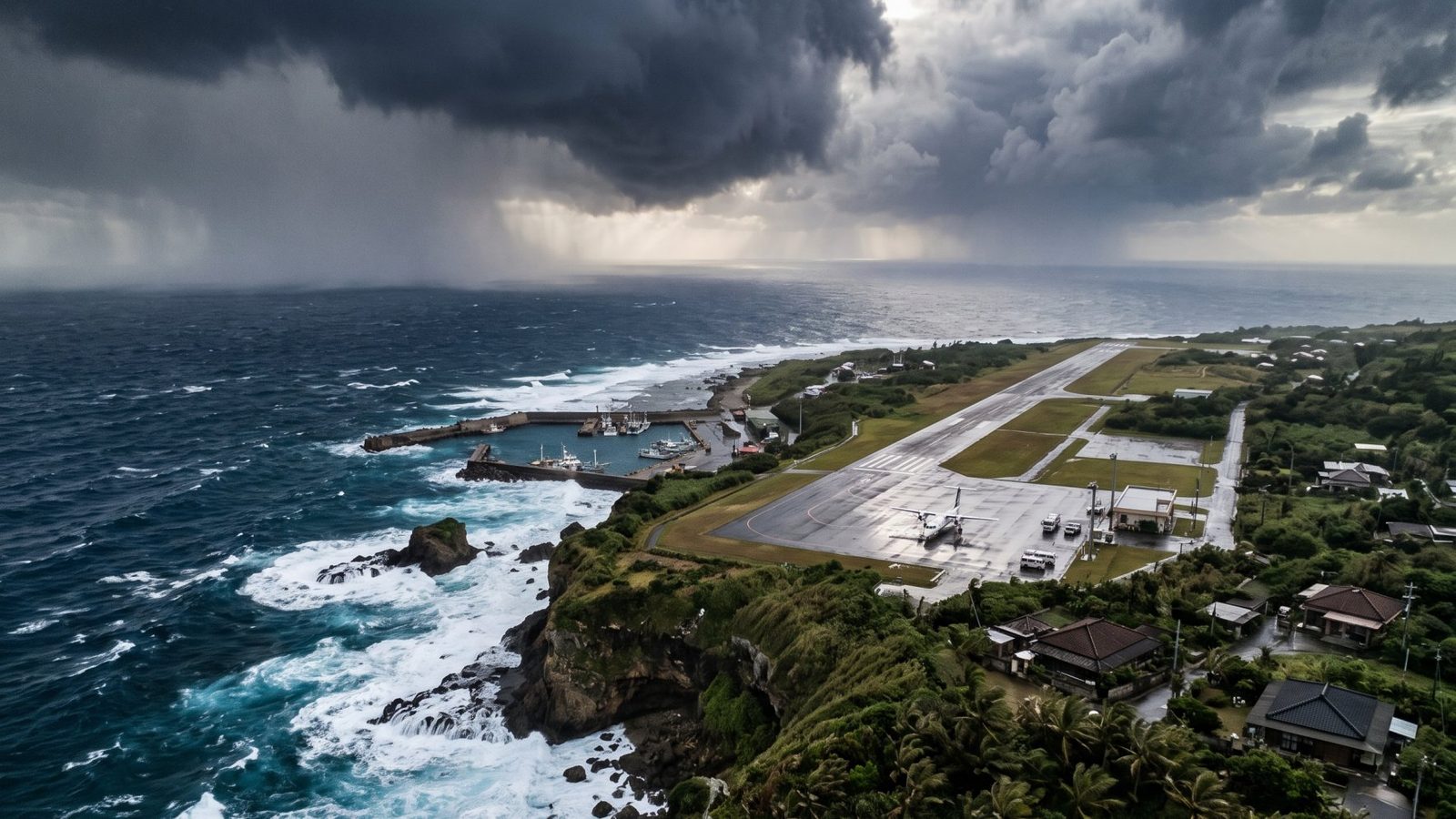
Yonaguni is small, remote and unusually exposed. The Japanese island sits roughly 111 kilometres from Taiwan and covers less than 30 square kilometres. Its population is approximately 1,600, according to local government figures from September 2026. Visitors come for dramatic coastlines, diving and the experience of reaching Japan’s western frontier. Yet those attractions depend on functioning roads, ports and air links. A storm need not pass directly overhead to interrupt them. High winds can stop transport, rough seas can delay boats and disrupted deliveries can affect businesses. Isolation turns an ordinary travel cancellation into a potentially extended stay for visitors.
Yonaguni’s Everyday Services Are Already Being Cut Back
The Yonaguni Town Government announced practical emergency measures on 22 October. Local buses stopped after the fifth service that day, with later departures suspended. Municipal schools and kindergartens closed, while Sonai nursery was set to remain shut on 23 and 24 October. The town office halted operations on Friday, 23 October. Rubbish collection and delivery services were also suspended for two days. These changes show that the threat reaches well beyond tourism. Residents must manage essential routines while visitors have fewer ways to move around. Okinawa Prefecture separately suspended administrative operations in the wider Yaeyama area as conditions deteriorated rapidly.
Japan and Taiwan Travel Disruptions Spread Across Okinawa’s Airports
Japan Airlines identified numerous cancellations affecting Yonaguni, Ishigaki, Miyako, Tarama, Kumejima and other southwestern airports between 22 and 24 October. All Nippon Airways also confirmed a full-day suspension of its services at Miyako and Ishigaki on 23 October. Okinawa’s Naha airport faced possible changes as well. The consequences extend beyond individual journeys. Many tourists connect through larger Okinawan airports before taking another flight to smaller islands. Once several airports face restrictions together, switching routes becomes difficult. Travellers holding tickets for the weekend should check their actual flight numbers and avoid assuming that every alternative connection will operate throughout the weekend.
Taiwan Flight Cancellations Deliver the Biggest Aviation Shock
The Taiwan Ministry of Transportation and Communications confirmed that all domestic flights scheduled for Friday, 23 October, would be cancelled. By 18:00 on Thursday, 22 October, regulators had already counted 126 domestic and 40 international flight cancellations, making 166 for that day alone. Many international cancellations involved services between Taiwan and Japan’s Okinawa region. This verified count should not be confused with a final total for the entire storm. More flights could change as conditions evolve. The shutdown leaves island residents, holidaymakers and connecting passengers facing disrupted journeys and uncertain return arrangements. Early communication is essential for passengers changing connections.
Extra Flights Show How Officials Tried to Avoid Stranding Passengers
Before the complete domestic suspension began, Taiwan’s Civil Aeronautics Administration arranged additional capacity to help travellers leave exposed islands. Uni Air and Mandarin Airlines operated extra services on routes linking Penghu with Kaohsiung and Taipei. The regulator reported two additional movements on each route on 22 October. It also instructed airports and airlines to publish clear disruption notices and plan for demand when services restart. Authorities considered emergency transport support if necessary. The early response matters because an island airport cannot instantly absorb several days of delayed passengers. Clearing backlogs safely may require extra aircraft, crews and available landing conditions.
International Flight Networks Feel the Impact Beyond Taiwan
The disruption reaches passengers far outside the storm zone. Singapore Airlines cancelled four flights connecting Singapore and Taipei on 23 October. Thai Airways announced six cancelled services on its Bangkok–Taipei and Bangkok–Kaohsiung routes. Malaysia Airlines confirmed two cancellations between Kuala Lumpur and Taipei. Together, those specific announcements account for 12 international flight cancellations. They are examples, not a complete tally across every carrier. Travellers connecting onward from these airports could also face missed transfers or altered accommodation plans. International services may resume at different times, depending on airport conditions, available aircraft and each airline’s operational decisions in the days ahead.
Ferry Suspensions Cut Vital Routes Across Taiwan’s Offshore Islands
The Taiwan Maritime and Port Bureau reported 106 cancelled ferry sailings across ten routes for 23 October. Services linking Donggang and Yanpu with Xiaoliuqiu were affected, along with connections to Penghu, Green Island, Orchid Island, Kinmen and Matsu. Some routes across the Taiwan Strait to ports in Fujian were also suspended. Sea travel presents a separate risk from aviation. High waves and strong crosswinds may persist after the eye has moved away, making an immediate restart impossible. Officials advised travellers not to begin unnecessary offshore island trips. Staying on the mainland is safer than risking an extended wait for transport.
Remote Island Tourism Faces a Difficult Chain Reaction
A cancelled ferry can disrupt far more than a boat journey. Guests may lose access to booked accommodation, diving trips, guided excursions or onward flights. Small island businesses also depend on predictable arrivals, food deliveries and returning residents. Champi threatens this connected network around Penghu, Xiaoliuqiu, Green Island and Orchid Island, as well as Japan’s southwestern islands. However, the full financial cost cannot yet be measured from official cancellation notices. Tourist numbers, refunds and business losses will need later assessment. For now, the practical problem is access. Travellers should secure confirmed transport before making fresh island reservations or changing accommodation.
Taiwan Closes 117 Tourist Attractions as a Precaution
Taiwan’s Tourism Administration announced the precautionary closure of 117 attractions managed by eight national scenic area administrations. The affected places include Fulong Beach, Turtle Island, Yehliu Geopark, Heping Island, Sanxiantai and destinations on Green Island. Officials listed 45 closures along the eastern coastal administration’s network, 20 in northern coastal areas and 12 around the north-eastern coast. Walking trails, beaches and visitor centres feature among the restricted sites. The closures are preventive, not evidence that every attraction has suffered damage. They protect visitors from flying debris, dangerous surf, landslides and sudden weather changes. Reopening requires separate local safety decisions and inspections.
Weekend Tourism Events Fall Victim to the Weather
The storm has also disrupted planned cultural and outdoor experiences. Taiwan’s Tourism Administration postponed a tribal dining event originally scheduled for 24 October, moving it to 22 November. A hiking activity in Nanzhuang shifted from 24–25 October to 7–8 November. Another cultural dining event moved to 14 November, while a Maolin cycling activity was rescheduled for 15 November. Such changes affect visitors, guides, catering teams and smaller businesses that rely on weekend demand. Yet postponement is not the same as cancellation. Organisers can preserve an event by moving it to safer dates. Ticket holders should confirm all revised arrangements directly.
Rail Disruption Adds Pressure, but Taiwan Is Not Completely Closed
Air and sea cancellations have drawn attention, but railway and road travellers also face changes. A Tainan City Government bulletin issued at 04:00 on 23 October said Taiwan Railways had suspended reserved-seat services on the western main line and South-Link Line, with other trains operating according to conditions. Some long-distance coaches stopped, city buses followed typhoon timetables and Tainan’s public bicycle service closed for the day. Crucially, the same update said Taiwan High Speed Rail was operating normally. Describing every Taiwanese transport service as suspended would therefore be wrong. Travellers need route-specific updates rather than sweeping national assumptions about closures.
Heavy Rain Raises the Risk of Flooding and Landslides in Taiwan
Wind speeds tell only part of Champi’s story. China’s National Meteorological Center forecast widespread rainfall of 100 to 200 millimetres across Taiwan between 22 and 25 October. Parts of the north-east could receive 400 to 600 millimetres, according to that forecast. Such amounts can overwhelm drainage systems, affect mountain roads and increase the danger of landslides. The figures describe possible accumulated rainfall, not measured totals. Taiwan’s weather agency also warned that the storm’s outer wind field was already affecting eastern land areas on Friday morning. Visitors should avoid exposed beaches, steep trails, riverbeds and low-lying roads during official weather warnings.
Eastern China Typhoon Warnings Put Coastal Travel on Alert
Eastern China could face dangerous weather even without a direct landfall. The National Meteorological Center warned of strong winds and rain affecting Zhejiang, Fujian, Shanghai and south-eastern Jiangsu. Its outlook put widespread coastal rainfall at 40 to 80 millimetres, with local amounts reaching 100 to 120 millimetres. The main rain period was expected on 23 and 24 October. Officials flagged the risks of flash flooding, urban waterlogging and hazardous coastal conditions. These warnings justify close monitoring by travellers and tour operators. They do not, however, establish mass flight cancellations at Shanghai, Hangzhou or other mainland airports without verified airline announcements.
Dangerous Seas Could Outlast the Strongest Winds
China’s forecasters warned that Champi and cooler air could combine to produce marine winds from 22 through 26 October. The affected waters include the East China Sea, Taiwan Strait, Hangzhou Bay and approaches to the Yangtze estuary. Marine hazards may restrict ferries, fishing vessels, coastal sightseeing and offshore work even after land conditions improve. For travellers, this creates a difficult timing problem: a clear sky does not guarantee a safe crossing. Operators must judge waves, winds and port conditions before resuming service. Anyone with a sea connection should wait for a confirmed sailing, rather than travel to a closed terminal.
The Next Decision for Travellers Is Safety, Not Speed
Typhoon Champi 2026 could continue disrupting journeys as it turns towards the East China Sea and later approaches waters nearer Japan. Travellers should follow local weather warnings, verify flights directly with airlines and check ferry or train services before leaving accommodation.
Taiwan’s Tourism Administration says qualifying force-majeure circumstances, including official transport suspensions or relevant local closure announcements, may entitle guests to full refunds of accommodation deposits and related charges. Keep cancellation notices and booking records. Above all, separate confirmed disruptions from forecasts. Champi’s centre may weaken, but coastal hazards and transport backlogs can continue long after the strongest winds pass.
The post Typhoon Champi’s Uncertain Turn Puts Japan, Taiwan and Eastern China on the Same Travel Watch appeared first on Travel and Tour World














































Comments and Responses
Please login. Only community members can comment.