























































Shahr-e Sukhteh Iran: Ancient Desert City for Heritage Travel & Archaeological Tourism
-
Blogs, Entertainment, Nature & Wildlife, History & Art, Religion, Travel
-
-
6 mins
-
Travel and Tour World
-
Akash Bagchi
-


Shahr-e Sukhteh, Iran’s ancient “Burnt City”, invites heritage travellers to explore well-preserved Bronze-Age ruins in the desert — a serene destination for archaeology and history enthusiasts.
Unearthing Shahr-e Sukhteh — Geography, History & Significance
Located in southeastern Iran, in the province of Sistan and Baluchestan, Shahr-e Sukhteh occupies a desert-edge promontory between the seasonal wetlands of Lake Hamun and the Helmand River.
This ancient settlement dates back to around three thousand two hundred BCE. It flourished through multiple phases and served as one of the earliest complex urban centres on the Iranian plateau.
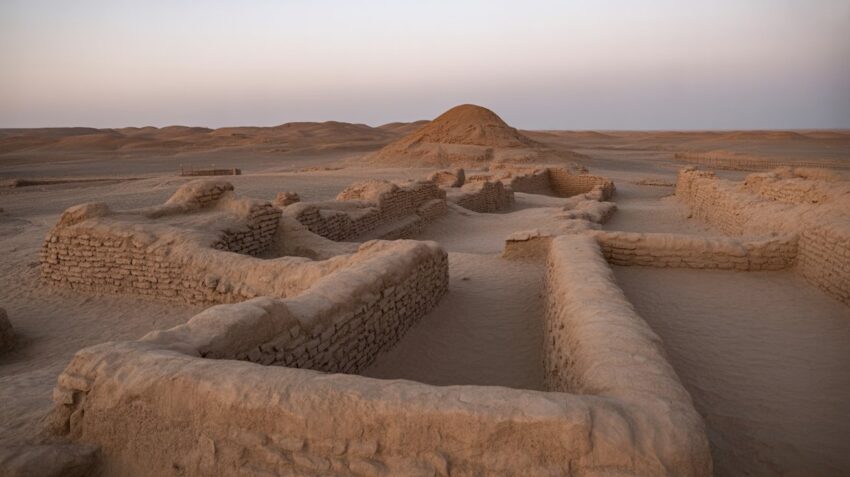
Archaeological evidence reveals that the city was organized across distinct functional zones: a monumental core, residential quarters, craft and industrial sectors, and a large necropolis.
During its zenith, Shahr-e Sukhteh was deeply embedded in long-distance trade networks — linking with regions on the Persian Gulf, the Indus plain, and Central Asia — serving as a hub for metallurgy, pottery, gem and stone-vessel production, and craft-work.
Because of its historical and archaeological value, the site was inscribed on the list of UNESCO World Heritage sites in two thousand and fourteen.
Today, Shahr-e Sukhteh stands as a critical witness to one of humanity’s earliest urban civilizations — offering rare insights into ancient urban planning, early metallurgy and craft industries, and cross-cultural interactions in the third millennium BCE.
Archaeological Riches & Heritage Value
- Urban planning and complex society: The layout — with separate zones for dwelling, industry, craft, ceremonial monuments and burial grounds — testifies to a structured, stratified and technologically adept ancient community.
- Craft, trade and economy: Finds include fine pottery, stone vessels, stamp seals, metalwork, gemstone and mineral processing — pointing to a vibrant economy with specialized crafts, mass production and long-distance trade.
- Cultural and civilizational links: The data indicates contacts with distant civilizations — not just within present-day Iran, but also across the Persian Gulf, the Indian subcontinent and Central Asia — shedding light on early connectivity in Bronze Age West and South Asia.
- Preservation and authenticity: The arid desert climate has helped preserve mud-brick structures, burial grounds and artifacts. The visible earth-mounds, ruins and layout maintain a sense of authenticity and continuity.
Because of its outstanding universal value under multiple criteria — early urbanization, demonstration of ancient craft & trade networks, and cultural exchange — Shahr-e Sukhteh is recognized globally as a key Bronze-Age heritage site.
Tourism Angle: Why Shahr-e Sukhteh Matters for Heritage Travel
Heritage-tourism & Archaeological Exploration
For travellers fascinated by prehistory and ancient civilizations, Shahr-e Sukhteh offers a rare opportunity to step into a five-millennia-old urban center. Exploring its ruins, mounds, and desert surroundings evokes a sense of walking through early human history.
Unlike crowded monuments or reconstructed heritage sites, the remote desert setting and preserved ruins give visitors a genuine — and largely unspoiled — experience of antiquity.
Cultural & Educational Value
Visiting Shahr-e Sukhteh is not only about sightseeing; it offers educational value — a tangible window into early urban planning, craft -based economy, ancient trade links, and early societal organization. For history and archaeology enthusiasts, this makes it a rich, immersive field.
Academic and research-oriented tourism (e.g. guided archaeological visits, study tours, heritage conservation workshops) can add deeper value, promoting knowledge and awareness about ancient civilizations and their relevance to modern cultural heritage.
Off-beat & Slow Travel Appeal
Given its remote location, lack of mass-tourism infrastructure, and peaceful desert surroundings, Shahr-e Sukhteh appeals to travellers seeking solitude, contemplation, and a connection with history away from commercial tourism circuits. It attracts those who appreciate slow, thoughtful travel rather than rushed sightseeing.
Integration with Regional Heritage & Natural Landscape
Shahr-e Sukhteh lies near other points of interest — desert landscapes, seasonal wetlands like Lake Hamun, traditional villages, and regional cultural heritage. A combined itinerary can offer a blend of archaeology, culture, nature, and rural lifestyle, making it a compelling destination for heritage-plus-nature travel.
Encouraging Sustainable & Responsible Heritage Tourism
Because the site is fragile and historically important, tourism at Shahr-e Sukhteh — if managed carefully — can be a model of responsible heritage tourism: low impact, respectful of conservation, and focused on education rather than entertainment or exploitation.
Challenges, Risks & Impact of Tourism at Shahr-e Sukhteh
Remoteness & Access Constraints
Shahr-e Sukhteh is situated far from major urban centres, in a desert region. The travel infrastructure is limited, and reaching the site typically involves long drives from nearby towns — which can deter average tourists and limit visitor numbers.
Lack of Tourist Amenities & Infrastructure
Because it remains primarily an archaeological/heritage site — not a developed tourist resort — there are minimal facilities: few (if any) hotels, no luxury amenities, limited shade or shelter, and little commercial infrastructure for tourism. This restricts the appeal to only those prepared for rustic, minimal-comfort travel.
Preservation vs. Tourism Pressure
While the site’s ruins are well preserved thanks to the arid climate and dry soil, unregulated tourism could pose threats: erosion, damage to fragile mud-brick structures, vandalism, littering, disturbance of archaeological context, and possible looting or unauthorized excavations.
Seasonality & Harsh Climate
The desert climate — with extremes of heat, aridity, and seasonal fluctuations — can make visits challenging, particularly in summer. The harsh environment may limit visitor comfort and increase the need for careful planning, supplies and precautions.
Limited Outreach & Awareness
Because Shahr-e Sukhteh is less known globally compared to famous heritage sites or major tourist circuits in Iran, it has limited exposure, which restricts tourism flow. This anonymity — while protective — also limits economic and cultural benefits that more recognized sites receive.
Potential Tourism Impact: Benefits & Strategic Value
If approached thoughtfully and sustainably, tourism around Shahr-e Sukhteh could deliver a number of lasting benefits:
- Heritage Preservation & Awareness: Responsible visits can raise global awareness about ancient Iranian civilizations, encourage heritage conservation and attract academic interest — which in turn supports preservation efforts.
- Diversifying Tourism Portfolio of Region: For Iran, this site offers a different archetype of tourism — not just monuments or religious/cultural centres, but deep-history, archaeology-driven travel — which can attract niche travellers (archaeology buffs, heritage tourists, cultural anthropologists).
- Educational & Research Tourism: Universities, researchers, heritage scholars could use the site for field studies, archaeological research, cultural-heritage education — making the site a living classroom for ancient history and human civilization.
- Local & Community-Based Opportunities: While large-scale infrastructure may not be desirable (and may even be harmful), small-scale eco / heritage tourism (guest-houses, guided tours, local craft demonstrations, conservation-oriented travel) could benefit local communities and promote traditional livelihoods — especially if managed by local stakeholders.
- Model for Sustainable Heritage-Tourism: Shahr-e Sukhteh could set an example of low-impact, education-focused heritage tourism, balancing visitor interest with conservation — a model increasingly relevant as global tourism seeks more sustainable forms.
Strategic Recommendations for Developing Shahr-e Sukhteh as a Heritage Destination
For Shahr-e Sukhteh to realize its potential as a meaningful destination for heritage tourism — without compromising its archaeological integrity — the following strategic priorities should be considered:
- Controlled access and permit-based visitation
Limit visitor numbers through permits; enforce guidelines for visitor behaviour, waste disposal, and preservation awareness. - Guided heritage tours and educational visits
Promote organized tours led by trained guides (archaeologists, heritage experts) rather than ad-hoc individual visits — ensuring both visitor safety and site protection. - Minimal-impact infrastructure only
Develop only essential facilities — basic shelter or shade structures, sanitation, water supply — avoiding large-scale commercial or hospitality development that could damage the site’s authenticity. - Local community involvement
Engage nearby communities in heritage tourism — local guides, artisans, small guest-houses, cultural interpretation — so that tourism yields meaningful, sustainable benefits for inhabitants. - Research and monitoring integration
Combine tourism with ongoing archaeological research and conservation efforts; use a portion of visitor fees to fund site conservation, documentation, and maintenance. - Global awareness & heritage marketing (selectively)
Promote Shahr-e Sukhteh among niche audiences: history buffs, archaeologists, cultural-heritage travelers, educational institutions — rather than mass tourism markets. - Responsible seasonal planning
Encourage visits during cooler, milder seasons; discourage tourism during extreme summer heat. Provide clear guidance for safety, hydration, and environmental respect.
The Meaning of Shahr-e Sukhteh for Future Heritage Travel
Shahr-e Sukhteh stands among the rare surviving testaments to early urban civilization in the rugged deserts of southwestern Asia. As an archaeological treasure, it offers a glimpse into the ingenuity, craft, trade and urban life of people living more than five millennia ago.
For the modern world — increasingly aware of heritage loss, homogenized tourism, and environmental degradation — Shahr-e Sukhteh offers a path: heritage tourism rooted in respect, education, and minimal impact. This desert relic reminds us that human history is deep, that civilizations emerged in many environments, and that preserving such fragile traces is a global responsibility.
If handled with care, Shahr-e Sukhteh can become a beacon for slow, meaningful cultural tourism — inviting visitors to reflect on human origins, diversity, and the passage of time — without turning one of our oldest urban memories into a commercial spectacle.
Heritage-Tourism Summary
Shahr-e Sukhteh — ancient, remote, largely unknown compared to famous heritage cities — holds the quiet power of history. For travellers drawn to antiquity, archaeology, and silence under desert skies, it promises a unique encounter: with ancient urban planning, Bronze-Age crafts, and the footprints of early global trade.
With careful stewardship, modest infrastructure, and community-based management, it could emerge as one of the world’s most inspiring destinations for heritage- and archaeology-oriented travellers — a “must-visit” not for crowds, but for contemplation, discovery and respect for our shared human past.
Preserving Past, Inspiring Future — Shahr-e Sukhteh’s Potential as a Living Heritage Destination
Shahr-e Sukhteh of Iran remains a silent but powerful testament to early urban civilization in a harsh desert environment — its ruins, artefacts, and layout offer an irreplaceable window into human history. With mindful tourism, community-driven management, and heritage-conscious practices, it could be preserved for generations to come — while giving the world a rare chance to experience our ancient roots in a landscape of dust, stone, and timeless memory.
The post Shahr-e Sukhteh Iran: Ancient Desert City for Heritage Travel & Archaeological Tourism appeared first on Travel and Tour World














































Comments and Responses
Please login. Only community members can comment.