



























































From Singapore To Sydney: Affluent Travellers Turn Grand Prix Weekend Into An Asian Adventure
-
Culinary, History & Art, Shopping, Travel
-
-
4 mins
-
Travel and Tour World
-
Saoli TTW
-


Affluent travellers boost post-race tourism across Asia after the Singapore Grand Prix with higher spending and contactless payments.
Once the engines of the Formula 1 Singapore Grand Prix had quietened, the Singapore Grand Prix weekend marked the beginning of an extended holiday for many global travelers. The excitement of the race drew many to the Singapore Grand Prix weekend, and many then decided to holiday in the rest of the continent and Regions. Unlike Formula 1, which operated at a constant service, International travelers spent their time in the region and added to their spending, in stark contrast to their average spending.
Singapore as a Regional Gateway
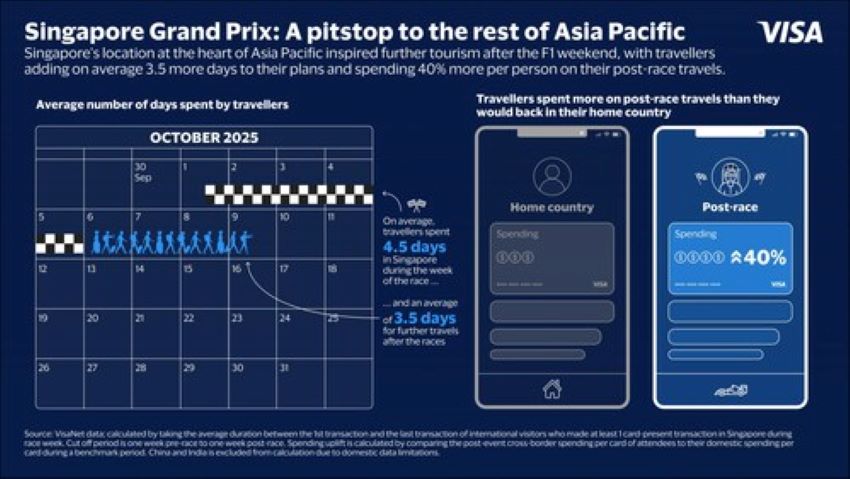
Singapore has long positioned itself as a vibrant meeting point between East and West. The Grand Prix weekend once again confirmed its role as a catalyst for regional travel. Approximately 20% of visitors who come into Singapore during the Grand Prix weekend went on to other regions. Visitors spent an additional 3 1/2 days in the region in the Asia-Pacific before returning to their countries.
Long-haul visitors from Europe, North America, and Oceania were also strongly drawn to extended exploration. About a third of these visitors went to another country after the race, making Singapore the start line and crossroads to the rest of Asia. The most popular onward country destinations were Indonesia, Malaysia, and Thailand. These countries were only a few hours away and were and still are, immensely laden with tropical beauty, culinary variety, and captivating culture. Australia and Japan also appeared to be the favoured destinations, a bit farther away for the long-haul globally extended Grand Prix trip.
The Post-Race Traveller’s Expenditure and Lifestyle Behaviour
The economic analytics specified that these post-race visitors also had the typical ‘tourist premium’ of about forty percent on their expenditure. They also had a considerable portion of the trip dedicated to either ‘entertainment’ or ‘dining’ for the Southeast Asian countries and ‘outlet retail shopping’ for Australia and Japan. These levels of spending reiterated the influence a major event can have on a traveller’s decision and also on the economic growth of multiple countries.
Among these travellers, the affluent group stood out clearly. About a quarter of affluent cardholders made onward travel plans, exceeding the overall average. Their journeys often stretched to Europe and North America, demonstrating a higher level of disposable income and travel enthusiasm. This segment spent roughly twenty percent more per person than other travellers during post-race trips, with significant outlays in department stores and luxury fashion. Their choices underscored a growing appetite for premium experiences that combine sport, leisure, and culture.
Contactless Payments Fuel Travel Convenience
Another noteworthy trend shaping modern travel is the widespread use of contactless payments. Singapore, already known for its advanced digital infrastructure, proved an ideal starting point. Around eighty-five percent of in-person transactions made by travellers who continued their trips after the race were contactless. This habit persisted wherever they went, with markets such as Australia and the United Kingdom approaching near-universal contactless usage at about ninety-five percent of transactions.
Despite the ongoing developments of digital payment systems in Japan, Malaysia, Indonesia, Thailand, Vietnam, and Cambodia, over eighty percent of transactions were contactless in these countries. This shows that the whole region has started to assess the move to secure, frictionless, and technology-facilitated transactions. Moreover, the Asia-Pacific region has promoted the efficiencies of digital payment systems and the safety and satisfaction of international visitors in its tourism sector. This has also been of considerable importance to safety and efficiencies in the region’s tourism digital systems.
Economic and Tourism Impact
The value of hosting major international events such as the Formula 1 Grand Prix has been highlighted by Singapore’s government authorities. It has been mentioned by the Ministry of Trade and Industry’s public and official presentations that the Grand Prix has been stimulating incremental tourism of billions of Singapore dollars and international visitors since 2008. Much of the hospitality, retail, transport, and culture of the whole city has been positively and culturally impacted beyond the race circuit.
The benefits of the spill-over effect also accrue to adjacent countries. Attendees of the Southeast Asia Games hosted in Indonesia have been the justification for the Ministry of Tourism and Creative Economy’s positive traffic reports. At the same time, Indonesia’s regional tourism competitors, particularly Malaysia and Thailand, have embarked on joint promotional campaigns to encourage multi-destination travel. Tourism agencies in Australia and Japan also observe the same phenomenon and correlate the increased visitor arrivals to Asia-based sporting and cultural events, highlighting increased intra-regional travel.
High-value travellers continue to segment and define regional tourism.
Analysis carried out by Visa demonstrates that high-value travellers are trendsetters in the post even tourism industry. Their propensity to engage in multi-destination travel, combined with their economic spending power, helps tourism planners and businesses forecast with more certainty. As such, the expectations of luxury hotels, high-end retailers, and fine-dining establishments pivot on the importance of personalisation, sustainable practices, integrated technology, and seamless causal transitions in service.
High-value air travellers are the key target for countries with integrated air travel networks and flexible visa regimes. With integrated marketing campaigns that feature Singapore, tourism authorities in Southeast Asia promote regional extensions to major international events. Singapore’s neighbours funnel traffic to their countries after major international events and capture the secondary flow of traffic, while Singapore receives the bulk of the flow from air travel.
Additional Implications for Travel Growth in the Asia-Pacific Region
The conclusions of the study indicate to decision makers and tourism professionals the simple and powerful reality that contemporary tourists do not primarily engage in single-destination travel with a single purpose. Tourists want to engage in a seamless combination of travel activities in a single journey. To maintain the current trend of multi-purpose travel, enhanced and secure digital frameworks, streamlined visa arrangements, and safe transport systems must be provided.
The Asia-Pacific region has embraced and streamlined cross-regional travel agreements, integrated tourism infrastructure, and digital travel services. Travel corridors, enhanced contactless payment systems, and the digitalisation of travel services in the region increase travellers’ sense of safety and enjoyment.
The region has embraced and streamlined cross-regional travel agreements, integrated tourism infrastructure, and digital travel services. Travel corridors, enhanced contactless payment systems, and the digitalisation of travel services in the region increase travellers’ sense of safety and enjoyment.
The Formula 1 weekend in Singapore not only reminisces about the memories of exhilarating motor races but also orchestrates an endless stream of multi-hop tourists. This includes families and affluent cross-border tourists. The Formula 1 weekend in Singapore not only reminiscesabout the memories of exhilarating motor races but also orchestrates an endless stream of multi-hop tourists. This includes families and affluent cross-border tourists.
This combination of thrill, movement, and innovative tools is indicative of the future of tourism in the Asia-Pacific regions. For numerous tourists, Singapore is not the final destination, but the beginning of an exceptional journey that is undertaken after the race, linking together an intricate web of countries, cultures, and experiences.
The post From Singapore To Sydney: Affluent Travellers Turn Grand Prix Weekend Into An Asian Adventure appeared first on Travel and Tour World

























































Comments and Responses
Please login. Only community members can comment.