























































Bundos Fara: The Master of T’Boli Brass Casting
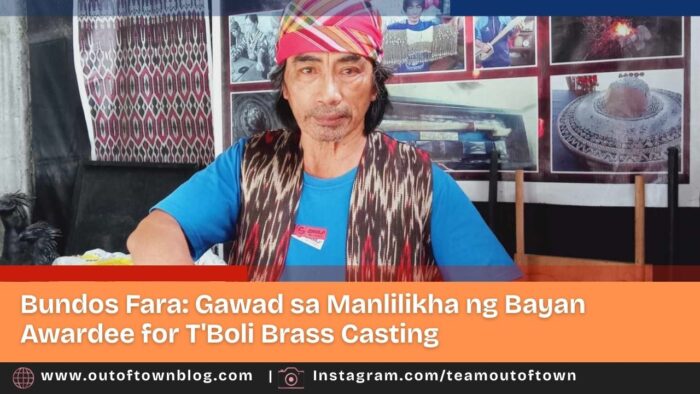
Bundos Fara Gawad sa Manlilikha ng Bayan Awardee for T’Boli Brass Casting
-
Travel, Blogs, History & Art
-
-
13 mins
-
Out of Town Blog
-
Team Out of Town
-


Bundos Fara: Gawad sa Manlilikha ng Bayan Awardee for T’Boli Brass Casting Bundos Fara is widely regarded as one of the most accomplished practitioners of traditional T’Boli brass casting, a craft deeply interwoven with ritual life, ancestral knowledge, and community identity. His recognition as a Gawad sa Manlilikha ng Bayan (GAMABA) awardee affirms not only […]
Bundos Fara: The Master of T’Boli Brass Casting
Bundos Fara: Gawad sa Manlilikha ng Bayan Awardee for T’Boli Brass Casting
Bundos Fara is widely regarded as one of the most accomplished practitioners of traditional T’Boli brass casting, a craft deeply interwoven with ritual life, ancestral knowledge, and community identity. His recognition as a Gawad sa Manlilikha ng Bayan (GAMABA) awardee affirms not only his exceptional skill but also his role as a vital bearer of an indigenous tradition that has endured for generations in Lake Sebu, South Cotabato.
Bundos Fara Gawad sa Manlilikha ng Bayan Awardee for T’Boli Brass Casting
A Craft Rooted in Ancestral Knowledge
T’Boli brass casting is one of the most technically complex traditional crafts in the Philippines. It has been handed down through generations and uses the ancient lost-wax method, a process that demands exceptional patience and precision.

Bundos Bansil Fara is a Filipino metalworker known for brass casting.
Bundos Fara starts each piece by hand-shaping beeswax into detailed forms, such as bells (k’lintang), gongs, and ritual ornaments. These wax models are then placed in clay molds, dried, and fired until the wax melts and exits, leaving a hollow space. Hot, molten brass is then poured into the mold, converting the raw metal into a resonant object that holds cultural significance.
Each stage of the process relies on experiential knowledge: knowing the best fire temperature, the exact wax thickness, and the optimal pour timing. These skills are acquired not through written instructions but through years of observation, practice, and mentorship from elders—wisdom that Bundos Fara has perfected over a lifetime of dedication.
The Temwel of the T’boli, South Cotabato
Bundos Fara is recognized locally as a traditional brass caster who learned his craft via the typical West African apprenticeship route. He started by assisting veteran metalworkers in his community, helping with clay-mold preparation, furnace operation, and finishing tasks. Over time, through diligent observation and practice, he mastered lost-wax (cire perdue) casting, a technique that has sustained regional brass production for centuries.
Fara’s influences were mainly cultural rather than academic. He was inspired by ancestral ritual objects, court regalia, and daily tools, along with teachings from senior casters who highlighted symbolism, proportion, and spiritual purpose. His themes and meticulous working methods were influenced by oral traditions, festivals, and community commissions. Instead of seeking innovation for its own sake, he prioritized staying true to the form and meaning.
His most enduring legacy is in preservation. Bundos Fara became a respected guardian of the craft, educating younger artisans and emphasizing traditional materials and techniques amid the rise of cheaper, industrial alternatives. He openly shared his knowledge, welcomed apprentices, and engaged in community demonstrations to maintain public interest. Through teaching, creating, and advocating, Fara helped ensure that traditional brass casting remained a vibrant, living art form rather than a museum exhibit—handed down through stories, skills, and fire.

Brass Products at Budos Fara Showroom

Bundos Fara Brass Products Showroom in Lake Sebu
Objects of Sound, Spirit, and Ceremony
The brass objects crafted by Bundos Fara serve more than just artistic purposes; they are vital elements of T’Boli ceremonial practices. Brass bells and instruments feature in healing ceremonies, farming rituals, weddings, and community festivals. In T’Boli belief, sound possesses spiritual energy—able to summon ancestral spirits, restore harmony, and reinforce social bonds.
Bundos Fara’s work demonstrates a profound grasp of this belief system. Each creation is designed not just for appearance but also for sound and utility, guaranteeing it serves its ceremonial role. His expertise is in blending beauty, acoustics, and spiritual purpose into one cohesive piece.
Discipline, Patience, and Cultural Integrity
Brass casting is a physically demanding and time-consuming process that can take days or weeks for a single piece. Despite these difficulties, Bundos Fara stays dedicated to traditional techniques, avoiding shortcuts or modern alternatives that might undermine cultural authenticity. His craftsmanship reflects core values such as discipline, humility, and respect for tradition, which are fundamental to T’Boli artistic practices.

Melo Villareal with Bundos Fara in Lake Sebu
Transmission of a Living Tradition
Aside from his personal accomplishments, Bundos Fara’s most significant contribution is his commitment to education. He has mentored younger community members, helping to pass down the techniques, values, and cultural significance of brass casting. This transfer across generations is vital for the craft’s continuation, turning it from a historical relic into an active, living tradition.

Tboli Belt made by Bundos Bansil Fara via Wikimedia Commons
National Recognition and Enduring Legacy
The Gawad sa Manlilikha ng Bayan awards those who exemplify the highest traditional craftsmanship while preserving their cultural heritage. Bundos Fara’s award highlights T’Boli brass casting as part of the national story, emphasizing the significance of indigenous knowledge to Philippine identity.
Through fire, metal, and memory, Bundos Fara keeps shaping more than just brass—he shapes ongoing tradition. His life’s work serves as a strong reminder that culture persists through those who practice, teach, and honor it daily.
Davao Travel Tour Packages You Should Try
<script type="text/javascript"></p> <p> (function (d, sc, u) {</p> <p> var s = d.createElement(sc),</p> <p> p = d.getElementsByTagName(sc)[0];</p> <p> s.type = "text/javascript";</p> <p> s.async = true;</p> <p> s.src = u;</p> <p> p.parentNode.insertBefore(s, p);</p> <p> })(</p> <p> document,</p> <p> "script",</p> <p> "https://affiliate.klook.com/widget/fetch-iframe-init.js"</p> <p> );</p> <p></script>
Follow and subscribe to OutofTownBlog.com on Facebook, Twitter, Instagram, Pinterest, and YouTube for more Travel-related updates.
Read:
- Get To Know South Cotabato’s National Living Treasures Awardees: Fu Yabing and Lang Dulay
- Meeting Apuh Ambalang, a National Living Treasure
- Top 14 Best LAKE SEBU TOURIST SPOTS + Things to Do
- Ways to Discovering Your Inner T’Boli
- Lake Sebu: South Cotabato’s Summer Capital
Bundos Fara: The Master of T’Boli Brass Casting
The post Bundos Fara: The Master of T’Boli Brass Casting appeared first on Out of Town Blog














































Comments and Responses
Please login. Only community members can comment.