
Baguio Beyond the Pines: An Artful, Sustainable, and Flavor-Focused Journey

Afternoon in Baguio City
-
Travel, Blogs, Wellness, Culinary, History & Art, Reviews
-
-
24 mins
-
Out of Town Blog
-
Melo Villareal
-


My journey took me from the sunny islands to the lush highlands, vividly contrasting environments that marked my recent travels. It started in Puerto Princesa City, Palawan, where I soaked in the beautiful town of Aborlan. We also participated in the Regional Travel Fair. Then, upon returning to the busy, chaotic Manila airport, we headed […]
Baguio Beyond the Pines: An Artful, Sustainable, and Flavor-Focused Journey
My journey took me from the sunny islands to the lush highlands, vividly contrasting environments that marked my recent travels. It started in Puerto Princesa City, Palawan, where I soaked in the beautiful town of Aborlan. We also participated in the Regional Travel Fair. Then, upon returning to the busy, chaotic Manila airport, we headed straight to Baguio City. Although the trip was exhausting, the cool air, pine trees, and Baguio’s lively streets instantly uplifted my mood. Baguio’s enchanting charm is irresistible—despite feeling tired, I always say yes to returning.
Afternoon in Baguio City
Baguio City has always been described to me in familiar strokes: the pine trees, the cold air, the traffic that somehow feels both sleepy and chaotic. But on this recent trip, I wanted to experience the city differently—slowly, creatively, and with curiosity for the people shaping its evolving culture. What I found was a Baguio that breathes art in unexpected corners, celebrates flavors shaped by altitude, and nurtures sustainable ways of living in a time when the city’s popularity threatens to overwhelm it.
This wasn’t a vacation. It felt more like an immersion in a mountain ecosystem of creativity.
The City as a Living Art Ecosystem
What struck me first was that art in Baguio isn’t confined to museums or curated halls—it’s woven into daily life.
On Session Road, I passed a group of students painting a makeshift mural on a wall that would probably be gone within a month. In tiny shops tucked between cafés, I saw shelves lined with handmade journals, eccentric ceramics, and weaving inspired by Cordilleran patterns.

Chantal Pangilinan in her Open Kitchen at Le Coq Bleu Homestay
We visited Le Coq Bleu, a Baguio homestay owned by Frenchwoman Chantal Michaut-Pangilinan and her Kapampangan husband, Boi Pangilinan. Despite its French flair, the homestay is anchored in local culture, with Cordilleran crafts, Filipino décor, and Chantal’s breakfasts that blend French techniques with regional ingredients like kiniing.
The rustic cottage, built from recycled materials and filled with vintage and eclectic pieces, embodies both sustainability and cultural preservation. As a host venue for the Ibagiw Creative Festival 2025, Le Coq Bleu Homestay showcased local art and craftsmanship, reflecting the festival’s spirit of creativity and heritage.

Kidlat Tahimik inside Ili-likha
Then there’s Ili-likha Artists Village, which looks like a treehouse built by someone who collects dreams and recycled glass for a living. Walking through it feels like stepping into a collective imagination—you find collages made of discarded tiles, sculptures assembled from scrap metal, and paintings that feel alive because they’re constantly being rearranged by the artists who live there.

Art Tibalo inside the Baguio Media Museum and Animation Studio
We visited the mini museum of Art Tibaldo, a Baguio-based ethnographer, multimedia artist, and journalist who connects art, culture, and communication in the Cordillera region. Known for documenting upland communities through photography, film, and writing, Tibaldo founded the Baguio Media Museum and Animation Studio—a “garage-cum-museum” tracing the evolution of communication from cave paintings to broadcasting through multimedia exhibits.
The space is both educational and a tribute to Baguio’s creative heritage. Through his work, Tibaldo fosters the city’s cultural identity, supports artists, and promotes Baguio as a UNESCO Creative City.
We had the unique opportunity to sit down and share meals with Marie Venus Tan, a passionate advocate for the interplay of art and wellness in Baguio. Tan envisions Baguio not just as a city, but as a vibrant nexus where artistic expression and holistic well-being intersect, shaping it into a space where “arts, gastronomy, and wellness meet.”

Marie Venus Tan at the Baguio Convention Center
Tan is deeply committed to inclusivity in the local arts scene, expressing her vision of Baguio’s evolution: “We must purposely progress as a Creative City.” Her leadership was pivotal in Baguio’s recognition as a UNESCO Creative City for Crafts and Folk Arts in 2017. She remains steadfast in her mission, fervently promoting continued innovation and honoring the city’s creative identity on the global stage.
Recognizing the importance of sustainability, Tan often speaks about the urgent need to institutionalize Baguio’s creative initiatives to ensure their impact extends to future generations. Her efforts are far-reaching, from advocating for policy to fostering collaboration among diverse cultural sectors.
Through her multifaceted approach, Venus Tan has firmly established herself as a visionary leader and a driving force behind Baguio’s artistic renaissance. She not only preserves the city’s rich traditions but also inspires the flourishing of new creative expressions, nurturing a community where both heritage and contemporary art thrive.

Artworks on display at Podium Boutique Hotel
We visited the Podium Boutique Hotel during our Ibagiw Festival Art Crawl, where works by various local artists were featured. Melan Ku Marquez curated the hotel’s interiors to blend hospitality and art, turning it into a dynamic gallery and reflecting Baguio’s UNESCO Creative City status. Her vision was for each space in the Podium to inspire appreciation and dialogue around local crafts and creativity.
In Baguio, art isn’t merely displayed. It grows, shifts, and adapts like the fog rolling in and out of the mountains.
Museums Without Walls
Of course, Baguio has its well-known museums—but it’s the small, surprising ones that left a mark. During the annual Ibagiw Festival, each participating restaurant turns into an art gallery showcasing local paintings, sculptures, and indigenous woven cloths. A local cafe served as an informal exhibition space for student work exploring themes of identity, climate, and land.
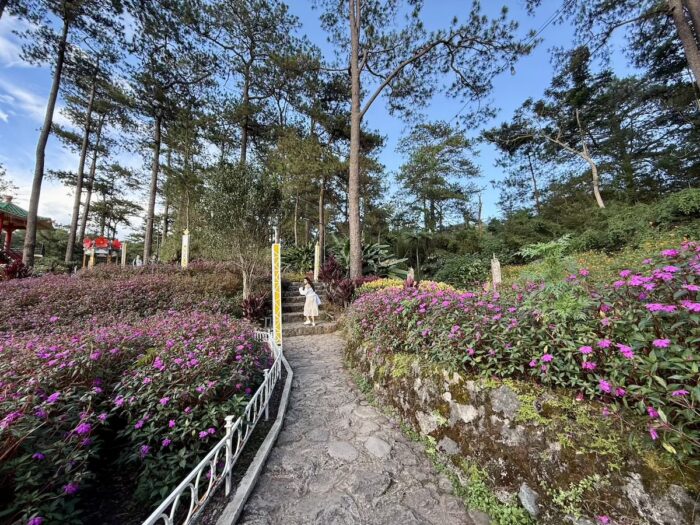
Baguio City Botanical Garden
In these spaces, the curation feels refreshingly raw. Unpolished. Honest.
There’s something about viewing art in Baguio’s highland light—the way the fog dilutes colors, softens shadows, and makes everything feel slightly dreamlike. Even indoors, the city’s mood seeps in. Paintings look different at different times of day. Sculptures seem a little more alive when mist clings to the windowpanes.
It made me think: maybe Baguio itself is the museum.
Slow and Sustainable Baguio
Every time I visit Baguio, I choose to walk.
From the Cathedral to the Public Market to Burnham Park, I traded jeepneys and taxis for footsteps, discovering small eco-stores, refill stations, and artist-led shops that repurpose discarded materials.
Walking also revealed the rhythms of the city: vendors setting up before dawn, students rushing to class, shop owners sweeping pine needles in Burnham Park. It grounded me in the slow-travel intention I brought with me—one that’s becoming increasingly important for a city struggling with overtourism.

Flower vendors in Burnham Park
A few steps from the Baguio cathedral, I discovered a cozy shop alive with the region’s colors and scents. Freshly made kakanin released a sweet, enticing fragrance, while bags of earthy ground coffee and bushels of vibrant vegetables caught the eye. There were shelves of herbal mountain teas, fresh ginger and turmeric roots, and sweets like golden peanut brittles offered as pasalubong.
Sustainability isn’t just a trend here; it’s an ingrained necessity, passionately upheld by artists, farmers, and local businesses determined to protect this calm mountain sanctuary they call home.
A Taste of Elevation: Culinary Stories Beyond Reviews
Baguio’s food scene tastes different—literally. At 1,400 meters above sea level, flavors behave in ways they don’t elsewhere.
Coffee feels brighter and sharper in the cold. Vegetables taste more alive: crisp spinach, earthy mushrooms, sweet strawberries, and greens that grow well only in this climate. Some cafés serve breads fermented slowly in the chilly air, resulting in a tang unique to the highlands.
Our recent Ibagiw Creative food crawl gave us the chance to savor the finest flavors the highlands have to offer. Yet, what truly stood out to me were not just the memorable dishes, but the meaningful stories behind them.
A farmer selling mushrooms at the market chatted about how Baguio’s temperature affects the mushroom caps, making them richer and meatier.

EVA Ritchelle Padua of Dulce Chocolate
We met EVA Ritchelle Padua, owner of Dulce Chocolate and a passionate Baguio-based chocolatier committed to building a chocolate empire that supports regional cacao farmers. She shared what makes Cordillera cacao stand out.
Beyond her passion, Eva described how the high-altitude farms infuse the cacao with a unique “terroir.” This combination of mountain climate, fertile soil, and elevation produces beans with nuanced flavors and helps preserve rare, heirloom cacao varieties distinctive to the Cordillera region.

Crackling Kabute
At Amare La Cucina, one dish stood out—a bowl of deep-fried mushrooms paired with a strawberry-infused vinegar I’d never tasted before. Chef Edmark Bustos chose to showcase local vegetables for this year’s Gastro × Art Creative Crawl because he believes that Baguio’s fresh produce is the heart and soul of local farmers. You can’t transport that flavor; it belongs to this altitude, Chef Edmark added.
Food in Baguio isn’t just fresh; it’s also deeply connected to its local heritage.
Baguio as a Creative Climate Refuge
There’s a reason artists, artisans, students, and dreamers gravitate to Baguio. The mountain air fosters a slower mind. The shifting weather invites introspection. The local communities create space for experimentation.
The city feels like a refuge—not just from heat, but from hurry.
As I walked its sloping roads, talked to its makers, tasted its hyperlocal ingredients, and watched fog swallow entire buildings, I understood why creativity thrives here. Baguio doesn’t merely house art; it inspires it.
Earlier this year, I visited Lubuagan in Kalinga and stayed at the house of Irene Bawer-Bimuyag, who now resides in Baguio. Irene is a textile artist, designer, embroiderer, and master weaver who comes from a long line of weavers in the Kalinga ancestral village of Mabilong, and her work celebrates both traditional and contemporary textile-making practices.
As part of the Gastro × Art Creative Crawl, her handwoven textiles are currently exhibited at Amare La Cunina. Her masterpieces are characterized by geometric and organic patterns, vibrant use of color, and intricate embroidery that bridges traditional Kalinga weaving techniques with contemporary artistic expression.
Taking Baguio Home
I left Baguio with more than memories—I carried a renewed respect for slow travel, for the value of supporting local communities, and for the intersections of culture, sustainability, and creativity.

Walis at Baguio Public Market
If you visit, seek the corners that don’t show up on tourist guides. Talk to artisans. Taste something made from the land. Spend a few hours in a space that doesn’t demand motion. Let the fog guide you—it has a way of revealing things just as it hides them.
Baguio isn’t just a destination. It’s a living, breathing work of art. And if you let it, it will shift something in you too.
Baguio Travel Tour Packages You Should Try
<script type="text/javascript"></p> <p> (function (d, sc, u) {</p> <p> var s = d.createElement(sc),</p> <p> p = d.getElementsByTagName(sc)[0];</p> <p> s.type = "text/javascript";</p> <p> s.async = true;</p> <p> s.src = u;</p> <p> p.parentNode.insertBefore(s, p);</p> <p> })(</p> <p> document,</p> <p> "script",</p> <p> "https://affiliate.klook.com/widget/fetch-iframe-init.js"</p> <p> );</p> <p></script>
Follow and subscribe to OutofTownBlog.com on Facebook , Twitter, Instagram, Pinterest, and YouTube for more Travel-related updates.
Read: Baguio City Travel Guide: Travel Requirements, Things to do, and More
Baguio Beyond the Pines: An Artful, Sustainable, and Flavor-Focused Journey
The post Baguio Beyond the Pines: An Artful, Sustainable, and Flavor-Focused Journey appeared first on Out of Town Blog
Comments and Responses
Please login. Only community members can comment.