
















































Bandung Faces New Tourism Safety Questions as BMKG Records 118 Earthquakes Across Indonesia’s West Java
-
Blogs, Culinary, Nature & Wildlife, Trip together, Travel
-
-
11 mins
-
Travel and Tour World
-
Angana Dutta
-

Bandung’s tourism safety is under fresh scrutiny after BMKG recorded 118 earthquakes across Bandung Regency and nearby areas between 11 August and 17 September 2026. With 13 tremors felt around Pangalengan, Talegong and Cisewu, the seismic sequence is putting traveller preparedness and reliable official information firmly into focus.
Quick Summary
- BMKG recorded 118 earthquakes from 11 August to 17 September 2026, around Bandung Regency.
- Multiple earthquakes were reported around Pangalengan, Talegong and Cisewu. The earthquakes had a magnitude of 1.0 to 3.4.
- The BMKG has not implemented a total closure of the area for tourism. Prospective travelers are invited to read BMKG statement and other official communications.
BMKG has reported 118 earthquakes between the dates of 11 August to 17 September 2026 around Bandung regency. This has caused renewed concerns about Bandung’s earthquake tourism safety. Bandung is home to the Pangalengan tourism area which is a popular nature and adventure destination in West Java. The greater Bandung area is home to many popular tourist destinations and experiences many local tourists. BMKG reported the earthquakes were shallow and in the magnitude range of 1 to 3.4 and 13 of which were felt by residents. BMKG and local officials stated that the earthquakes were from localized faults and that people should not be alarmed. They further stated that people should stay informed by official and verified sources.
BMKG Records 118 Earthquakes Around Bandung
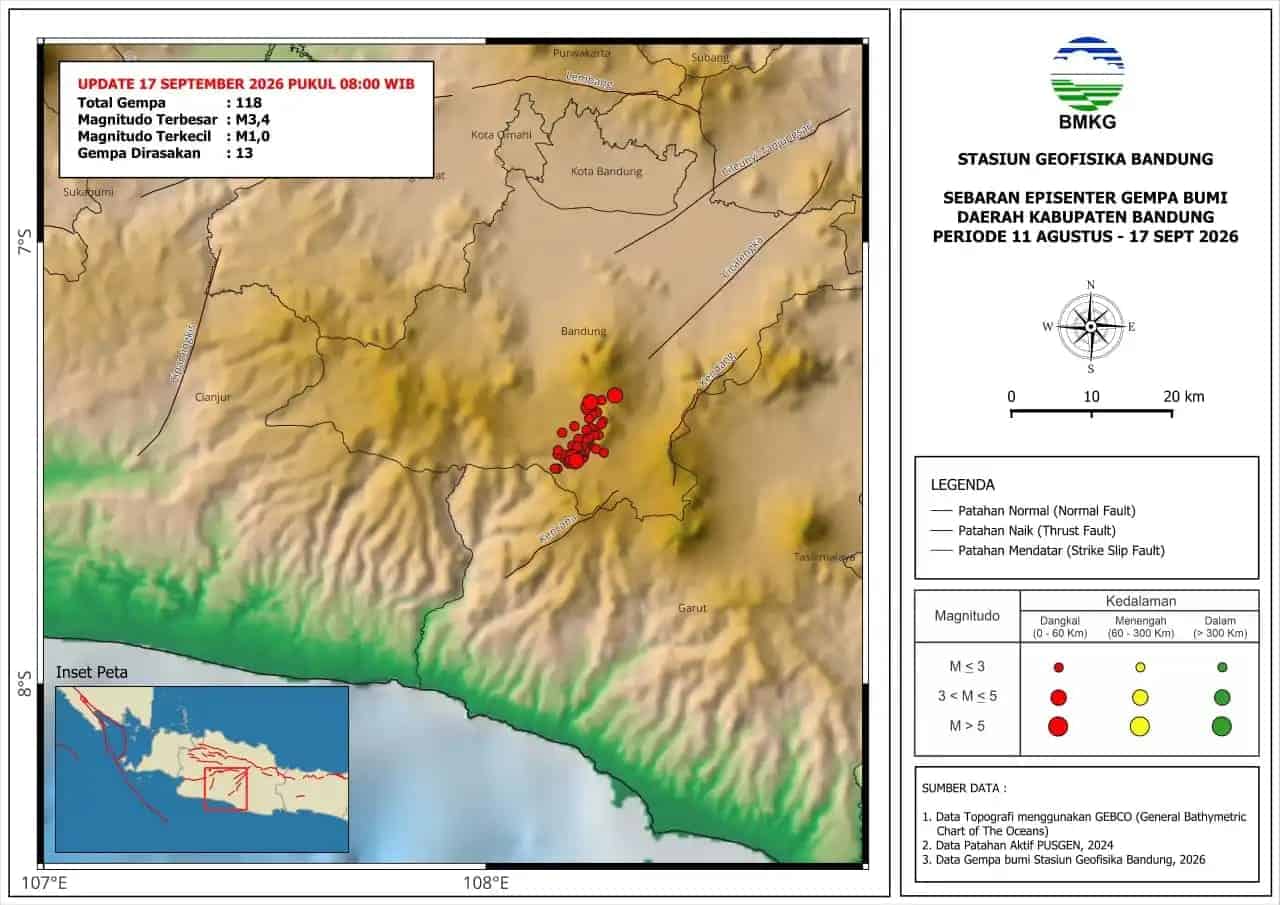
The latest official data puts the scale of the seismic sequence into perspective. Indonesia’s BMKG recorded 118 earthquakes in Bandung Regency and surrounding areas between 11 August and 17 September 2026, up to 08:00 WIB on 17 September.
The earthquakes ranged between magnitude 1.0 and 3.4. Thirteen were felt in Pangalengan, Talegong, Cisewu and surrounding areas, according to BMKG.
The felt earthquakes reached intensities of II to III on the Modified Mercalli Intensity scale. At that level, shaking can be clearly noticed indoors, but BMKG’s 17 September statement did not announce widespread destructive impacts from this sequence.
The agency classified the events as shallow earthquakes. Analysis of their epicentres showed a south-west to north-east alignment.
BMKG placed this activity about five to eight kilometres west of the Kendang segment of the Garsela Fault and north of its Kencana segment. The agency said the earthquakes were tectonically associated with active local fault activity.
That finding makes the episode relevant to travellers without justifying alarm. The correct response is greater awareness of local conditions and official safety information rather than treating the entire Bandung region as closed or inaccessible.
Read BMKG’s official 17 September earthquake assessment
What the Earthquake Data Actually Shows
The number 118 is striking, but the individual magnitude and intensity figures are equally important for travellers.
| Official indicator | BMKG finding |
|---|---|
| Monitoring period | 11 August–17 September 2026 |
| Earthquakes recorded | 118 |
| Magnitude range | M1.0–M3.4 |
| Earthquakes felt | 13 |
| Felt areas | Pangalengan, Talegong, Cisewu and surroundings |
| Reported intensity | II–III MMI |
| Earthquake type | Shallow |
| Geological interpretation | Associated with active local fault activity |
BMKG’s felt-earthquake database also recorded several events around southern Bandung immediately before the statement. A M2.7 earthquake at a depth of four kilometres occurred at 06:21 WIB on 17 September, with intensity III reported in Pangalengan, Talegong and Cisewu.
Another M2.6 event at a depth of three kilometres was recorded earlier that morning. Pangalengan and Kertasari reported intensity III shaking.
These observations explain why earthquake preparedness has become relevant for people staying or travelling in the affected southern Bandung area.
They do not, however, establish that every attraction, hotel or transport service across Bandung has been disrupted.
Why Pangalengan Matters to Bandung Tourism
The location is significant because Pangalengan is itself an important tourism area, rather than simply an isolated seismic monitoring point.
Bandung Regency’s tourism authority lists Taman Langit in Pangalengan among its featured tourism attractions. The local government’s tourism portal describes a wider sector containing 6,562 tourism businesses and 2,312 creative-economy participants across Bandung Regency.
Pangalengan’s tourism offer is heavily connected to its landscape. Nature, highland scenery and outdoor experiences form part of the visitor appeal.
The Bandung Regency Government’s development planning documents identify Pangalengan as one of the regency’s tourism destination areas. They associate it with nature, water-based tourism, educational experiences and special-interest tourism.
Official planning documents also identify attractions including Situ Cileunca, Malabar Plantation, Kertamanah Tea Plantation, rafting and other outdoor activities in Pangalengan. That makes preparedness particularly relevant because some visitor activity takes place in mountainous and open-air environments.
Bandung Entered the Seismic Period With Strong Visitor Volumes
Tourism statistics show why any safety development around Bandung deserves close attention.
According to BPS Statistics Indonesia for Bandung Regency, the regency recorded 1,197,309 domestic tourist trips in July 2026. Combined hotel room occupancy reached 22.75%.
In June, Bandung Regency received 1,185,203 domestic tourist trips, while hotel occupancy stood at 22.02%. In May, the corresponding figures were 713,551 trips and 21.80%.
Earlier in March, domestic tourism trips to Bandung Regency reached 1,318,486, an increase of 35.23% from February. Hotel room occupancy reached 24.11%, which was 3.93 percentage points above March 2025.
| Period | Domestic tourist trips to Bandung Regency | Hotel occupancy |
|---|---|---|
| March 2026 | 1,318,486 | 24.11% |
| May 2026 | 713,551 | 21.80% |
| June 2026 | 1,185,203 | 22.02% |
| July 2026 | 1,197,309 | 22.75% |
The data shows that Bandung Regency has a substantial domestic tourism economy. That creates a direct need for accurate safety communication when natural hazards develop.
It is also important not to confuse Bandung Regency with Bandung Municipality. They are separate administrative areas and their tourism statistics should not be merged.
Bandung City Adds Scale to the Regional Tourism Picture
Bandung Municipality recorded another 2,033,376 domestic tourist trips in June 2026, according to BPS. Its combined hotel room occupancy rate reached 54.58%.
In May, domestic trips to Bandung Municipality reached 2,267,410, up 13.72% from the previous month. Hotel occupancy increased to 53.41%, compared with 50.17% in April.
These figures should not be interpreted as visitor numbers for the specific earthquake zone. They demonstrate the economic scale of tourism in the broader Bandung area.
They also show why geographically precise reporting matters. A seismic cluster affecting southern Bandung Regency should not automatically be presented as a shutdown of Bandung city tourism.
West Java Tourism Depends Heavily on Domestic Movement
The wider provincial figures reinforce that point.
BPS West Java recorded 18.67 million domestic tourist trips to West Java in June 2026. Combined star and non-star hotel occupancy across the province stood at 40.44%.
In May, the province recorded 19.52 million domestic tourist trips. Hotel occupancy reached 39.06%.
Direct international arrivals through Kertajati Airport were comparatively small in those statistics. BPS recorded 241 direct international visitor arrivals through Kertajati in May and 477 in June.
That means the immediate tourism exposure around Bandung is strongly connected to Indonesia’s large domestic travel market.
Tourism Has a Wider Economic Importance for Indonesia
The safety discussion also sits within a much larger national tourism economy.
The Indonesian Ministry of Tourism, citing BPS Tourism Satellite Account data, reported that tourism directly contributed 4.78% of Indonesia’s GDP in 2025, equivalent to Rp1,138.90 trillion.
Total internal tourism consumption reached Rp2,408.97 trillion. Domestic tourism expenditure accounted for Rp2,090.31 trillion, while inbound visitor spending contributed Rp318.66 trillion.
The BPS Tourism Satellite Account covers tourism demand, tourism industries, economic value added, GDP and employment. It is designed to measure tourism’s economic role using internationally aligned statistical standards.
For destinations such as Bandung, resilience therefore matters beyond the traveller experience. Tourism activity supports accommodation, food services, transport, attractions, guides and a wide network of small businesses.
Bandung Earthquake Tourism Safety Moves Into Focus
BMKG’s findings make preparedness particularly important because the seismic activity has been persistent rather than limited to one isolated tremor.
The agency’s official assessment identifies an active local-fault connection. That provides a scientific basis for continued monitoring.
For tourism businesses, the practical issue is preparedness. Hotels, attractions and operators need clear procedures so guests know what to do if shaking occurs.
This is especially important for international visitors who may not understand local emergency information in Indonesian or know where evacuation areas are located.
Visitors staying in highland accommodation should identify exits and assembly areas when checking in. Tour operators working in mountainous areas should also remain attentive to official hazard information because earthquakes can create secondary risks in steep terrain.
Earthquake Risk Was Already Recognised in Bandung Planning
Earthquake exposure is not a newly discovered issue for Bandung Regency.
The Bandung Regency Government’s 2025–2045 Long-Term Regional Development Plan identifies Pangalengan, Banjaran, Cimaung, Kertasari and Cilengkrang as districts with earthquake-risk potential.
The document notes Bandung Regency’s geological exposure to tectonic and volcanic earthquakes. It also refers to local fault systems affecting the region.
This existing government risk framework is important. It means the latest earthquake sequence can be considered within an established disaster-management structure rather than as an entirely unexpected risk.
Bandung Regency’s BPBD, or Regional Disaster Management Agency, is responsible for disaster preparedness, emergency response, recovery and reconstruction. Its work covers hazards including earthquakes, landslides, floods and volcanic events.
The agency also operates disaster-risk information tools, including earthquake risk assessments for Bandung Regency.
Indonesia Has Already Been Expanding Earthquake Education
Preparedness work also extends beyond Bandung.
In September 2025, BMKG organised an Earthquake Field School in West Java involving students, residents and local authorities. The programme was intended to strengthen disaster awareness and community readiness.
BMKG maintains public educational material covering earthquake preparation, evacuation and post-earthquake safety.
The guidance stresses knowing exits and emergency stairs, securing potentially dangerous objects and keeping basic emergency equipment available. It also advises people to follow reliable information and avoid unverified rumours.
BMKG earthquake preparedness guidance
What Travellers Should Do During an Earthquake
BMKG provides clear advice for people caught in an earthquake.
If indoors, visitors should protect their head and body from falling material and seek a safer position away from hazards. BMKG’s guidance advises identifying emergency exits and stairs before an emergency happens.
People outdoors should move away from buildings, electricity poles, trees and other structures that could fall.
Travellers in mountainous areas should stay away from places where landslides may occur during or following shaking. That guidance has particular relevance for highland tourism areas around southern Bandung.
After an earthquake, BMKG advises people to leave buildings in an orderly way and avoid lifts. Visitors should also avoid entering damaged buildings because further shaking can occur.
Most importantly, travellers should follow BMKG and local authorities, rather than relying on unverified social-media posts.
What the Earthquakes Mean for Hotels and Tourism Businesses
The immediate challenge for hotels is not simply occupancy. It is guest confidence and emergency readiness.
Properties can reduce uncertainty by ensuring emergency routes are visible, staff know assembly procedures and guests receive accurate information.
For smaller accommodation businesses in rural tourism areas, basic preparedness is particularly important because guests may be unfamiliar with the terrain.
Tour operators have a similar responsibility. Itinerary decisions should be based on official information, local access conditions and instructions from authorities.
The latest BMKG release does not announce a blanket tourism closure. Travellers should therefore avoid interpreting the 118-earthquake count as evidence that the whole Bandung tourism region has stopped operating.
Airlines and Airports Require Geographical Perspective
There is also no basis in the cited official earthquake release for claiming that the sequence caused widespread aviation disruption.
The earthquake locations highlighted by BMKG were around Bandung Regency and neighbouring areas. Travellers flying into West Java should therefore check their airline and airport directly for operational information rather than assuming flights have been cancelled because of regional seismic activity.
BPS data nevertheless shows that aviation remains part of West Java’s visitor economy, with international visitors entering directly through Kertajati as well as travellers reaching Bandung through wider Indonesian transport networks.
Any confirmed operational change should come from the relevant airport, airline or transport authority.
Local Businesses Depend on Clear Information
The tourism economy around Bandung extends well beyond conventional hotels.
The Bandung Regency tourism authority lists thousands of tourism businesses and more than 2,000 creative-economy participants.
They include businesses linked to food, attractions, experiences, accommodation and other visitor services.
Poorly framed safety information can therefore have economic consequences. At the same time, minimising genuine geological risk would undermine traveller confidence.
The most useful approach is precise communication: state where earthquakes occurred, report their magnitude and intensity, identify official advice and update visitors when conditions change.
No Basis for Predicting the Next Earthquake
The latest activity should not be used to make unsupported predictions about what happens next.
BMKG’s 17 September statement describes the recorded sequence and its geological interpretation. It does not provide a prediction of a specific larger earthquake occurring at a particular time.
For travellers, that distinction matters.
A high earthquake count can understandably cause concern, but decisions should be based on official hazard information and actual restrictions rather than predictions circulating online.
What Visitors Planning Pangalengan Trips Should Check
Travellers heading towards Pangalengan or other parts of southern Bandung Regency can take several practical steps before departure:
- Check the latest earthquake information directly from BMKG.
- Ask the hotel or accommodation provider about its emergency and evacuation procedures.
- Confirm whether individual attractions are operating before travelling.
- Check local road conditions if travelling through mountainous terrain.
- Identify exits and assembly areas after arriving at accommodation.
- Keep essential medication, identification and communication equipment accessible.
- Follow local authority instructions if further earthquakes are felt.
- Avoid damaged buildings and areas identified as unsafe by authorities.
These measures are precautionary. They should not be interpreted as an official recommendation to cancel travel to Bandung.
Future Outlook Depends on Monitoring and Preparedness
The official outlook is centred on monitoring, scientific assessment and disaster preparedness.
BMKG’s identification of local active-fault activity provides authorities with additional seismic information for the Bandung region. Local government planning already recognises earthquake exposure in Pangalengan and several other districts.
That creates a clear policy link between tourism development and disaster resilience.
Bandung Regency’s official development documents continue to recognise Pangalengan as a tourism destination. There is no evidence in the sources reviewed for this report that the government has abandoned those tourism plans because of the latest seismic activity.
The priority is therefore to combine tourism development with preparedness, accurate public information and risk-aware infrastructure planning.
FAQs for Travellers
Is Bandung closed to tourists because of the 118 earthquakes?
No blanket tourism closure for Bandung was announced in BMKG’s 17 September statement. The agency reported 118 earthquakes between 11 August and 17 September and advised the public to remain calm and follow official information. Travellers should check individual attractions, accommodation and transport providers before departure.
Which areas have felt the earthquakes?
BMKG said 13 earthquakes were felt in Pangalengan, Talegong, Cisewu and surrounding areas, generally at intensities II–III MMI. Several events around Pangalengan were also listed in BMKG’s felt-earthquake records on 16 and 17 September.
What should tourists do if an earthquake happens while they are in Bandung?
Follow BMKG guidance. Protect yourself from falling objects if indoors, identify a safe exit, avoid lifts after the shaking and move away from buildings and other falling hazards if outside. In mountainous locations, avoid areas vulnerable to landslides. Follow BMKG and local government information rather than unverified online reports.
Conclusion
This series of earthquakes has exposed the need for improved disaster preparedness in one of West Java’s primary tourism regions. Recording 118 earthquakes in the area does not mean that BMKG recommends closing Bandung to the public. In fact, BMKG states that the earthquakes should not inhibit travel to the region. While there is a current threat level, the focus for authorities should be on distributing appropriate earthquake information based on BMKG assessments and creating action plans to respond to that information.
The focus for the public should be on action as well. The public should heed BMKG’s warnings and assessments of earthquakes and consider the threat level when determining their travel plans to the region. If an earthquake occurs, band together with your fellow travelers and seek out the safest areas. With continued preparations, threats to visitors and resident of the region can be lessened.
The post Bandung Faces New Tourism Safety Questions as BMKG Records 118 Earthquakes Across Indonesia’s West Java appeared first on Travel and Tour World























































Comments and Responses
Please login. Only community members can comment.